News
 Posted on: 21/10/2026
DET Ambassador Programme featured in PiXl Insights Publication
We are immensely proud to see our DET Ambassador programme featured in the latest PiXL Insights publication. Read the full featured article below:
Title: Empowering the under-served: The DET Ambassador Programme
Context
The Danes Educational Trust (DET) Ambassador Programme was born not from an abstract policy, but from a deeply personal mission to rewrite the narrative of educational disadvantage. Kate Rayner, the DET Ambassador Lead and a Food Technician at Onslow St Audrey’s School, came up with the programme based on her own lived experiences. Having once been a pupil at the school where she now works, the initial school of the programme, Kate’s unique perspective lies at the heart of the programme’s success.
As Kate reflects: "I used to be a disadvantaged pupil, in the 1990s, standing in a separate line to others, waiting for my free school meal ticket. I was told I was a plodder and would never succeed in life. I want to close the gap in attainment, and I want to offer a sense of belonging. I want to inspire ambition, to build on resilience, the grit and the growth mindset of our children. I want to grow a community based on tools and support. I want to grow this programme for children to achieve better than I did, believe in themselves, and not to feel any different from anyone else."
Kate’s past shouldn’t be a child’s present. Her perspective helped shape this programme to close the persistent attainment gap by nurturing a deep sense of belonging, inspiring ambition and cultivating grit, resilience and a growth mindset. Kate has taken her dream of a mentoring scheme with a few volunteers from her school and grown it into a powerful, trust-wide initiative that is changing the lives of children across Hertfordshire and now Buckinghamshire. To date, the programme has achieved significant scale, successfully engaging all 13 schools within the Trust.
Through the programme, we are able to learn more about our pupils. We gain a holistic understanding of what is going on in their lives inside and outside of school, and we are then able to tailor our support accordingly.
Intent
The imperative for intervention: Targeting "The unseen child"
In every school, a specific demographic of pupils consistently slips through the net. This initiative was launched as a targeted 1-to-1 mentoring program specifically for "our under-served pupils," meaning those quiet, vulnerable children who are often overlooked because they lack significant behavioural flags, Special Educational Needs (SEN), or high-aspirational markers. They are, in essence, "the unseen children" who navigate their school experience in silence without getting the speed or notice of others.
This project is all about making sure no pupil slips through the net. By giving them a trusted adult they can talk to 1-to-1, we are creating a safe space where they truly feel they belong. When children feel safe and supported, the barriers to learning reduce, allowing them to improve in class and actually enjoy their time at school.
This face-to-face support targets:
Socio-emotional barriers: Providing a dedicated, safe space to talk about problems and navigate personal worries regarding home or school life, thereby driving measurable gains in wellbeing, confidence and emotional resilience.
Practical and academic barriers: Addressing minor, easily overlooked issues that derail learning, such as lacking basic equipment like pens and pencils, seating plan discomfort, or hidden anxieties about specific classroom content and teacher relationships.
By offering these under-served pupils a trusted adult and a dedicated space to navigate personal barriers, the programme empowers unseen children, giving them the tools to believe in themselves and engage with their education with newfound purpose.
Scaling the programme
The rollout of the DET Ambassador Programme has been a phased expansion across the Trust. While Kate was initially asked to bring two schools onboard within a year, she quickly realised the importance of the programme and wanted to support under-served pupils across the whole trust. With encouragement, Kate actively contacted schools within the Trust to accelerate the rollout.
The programme was originally established in 2018 at Onslow St Audrey’s School with an initial cohort of 12 pupils and 5 staff. The school now has 40 pupils and 35 staff members, forming the structural blueprint for other schools. The programme expanded into the primary phase in September 2023 at De Havilland Primary School, where 13 pupils and staff engaged as Learning Champions. The 2024 academic year saw Chancellor’s School, Roselands Primary School, and The Cranbourne Primary School join. By 2025 DET Ambassadors included Lanchester Primary School, The John Warner School, Ascot Road Primary School, Jupiter Primary School and The Beaconsfield School. Today, the DET Ambassador programme proudly supports 189 pupils 1-1 across the Trust, a number that continues to rise due to the onboarding of Elstree Screen Arts UTC, St Clement Danes and Croxley Danes in September 2026.
Implementation
The programme includes individual sessions, group and whole year workshops. All pupils receive a 20 minute 1:1 mentoring session between themselves and a paired up staff member, this happens every two weeks. These sessions are supported by primary and secondary log books, which help guide the mentor. To establish a baseline each pupil completes a Google survey covering four areas of questioning based around grit, resilience, self-efficacy and growth mindset. These insights are shared with mentors to help them provide more targeted support and to identify exactly where pupils lack specific skills.
Once this baseline is established, the programme introduces targeted workshops. These workshops are directly informed by the trends and insights gathered during individual 1:1 sessions, ensuring the collective curriculum addresses genuine pupil needs. Examples of these sessions include:
Stress management workshops that normalise anxiety and stress as a natural feeling and equip pupils with concrete coping strategies
Metacognitive habits workshops which include how to sustain continuity. These sessions are designed to help pupils convert positive learning behaviours into long-term, sustainable habits. As one participant reflected:
“my mentor helped me with revision which I struggled with in the past so I’m thankful”
The success of the DET Ambassador programme is its fluidity. It is designed as a flexible, non-prescriptive model that can be adapted to the context and needs of any school or pupil. Despite initial challenges around how staff manage giving up their time, the mentor pool remains intentionally diverse. Mentors are not limited to teaching staff but are drawn from all colleagues across the school community, including support staff, premises managers, office staff and IT support teams. There is a trust-wide belief that every staff member can create a positive connection.
Mentors are kept informed of pupils' vulnerabilities by the programme lead, allowing for productive meetings where current issues can be effectively addressed. To facilitate this, mentors are encouraged to have honest and relaxed conversations with their mentees.
Meetings can take place indoors, outdoors, or via "walk and talk" formats, the core principle is to hold the 1:1 wherever the pupil feels most comfortable. This relaxed environment creates a unique space for open communication, with pupils noting they value “talking about stuff that doesn’t normally come up in class.” However, if a conversation becomes difficult or concerning, safeguarding rules strictly apply; staff are fully trained to escalate issues immediately to the programme lead and the safeguarding team.
The continuity of this programme is built to directly transition pupils from primary to secondary education. Most primary schools within DET share a strong secondary link; for example, De Havilland Primary School DET Ambassadors can move seamlessly into Onslow St Audrey's, both located in Hatfield and continue the programme.
Findings, evaluation and reflection
The success of the programme is anchored in the removal of previously unknown barriers to school, meaningful enrichment opportunities and the establishment of a structured mentor framework. By successfully bridging the gap between established school interventions, the programme is effectively laying the foundations for these pupils to establish long-term connections, a sense of belonging and improvement in academic and personal success.
Through the establishment of DET Ambassadors, we have successfully identified and supported under-served pupils.
The initial baseline data is reviewed alongside a concluding Google survey to track shifts in pupil grit, resilience, self-efficacy and growth mindset. This survey data is also evaluated alongside exam performance, assessment results and attendance records for both regular school days and the mentoring meetings themselves.
Initial feedback highlights a quantitative impact on participants. Mentors are already reporting notable, positive shifts in:
Pupil confidence and engagement, where previously unseen pupils are finding their voices, building eye-to-eye contact skills, and participating more actively in school life. The profound personal effect of this individual attention is mirrored in the feedback from the children themselves:
“Mentoring sessions has helped a lot, it gave me someone else to trust and talk to about things that affect my life which don't get spoken or asked about and sometimes a little talk goes a long way”
Attendance and emotional resilience, with early indicators showing positive developments in attendance patterns alongside an increased ability to handle day-to-day school stressors
A core element of the programme's design is pupil accountability. Attendance at mentor meetings and workshops unlocks access to reward trips and incentives linked to the programme. These enrichment experiences encourage pupils to…
Build upon resilience and teamwork, an example of this is using the high-ropes courses at Stanborough Lakes and climbing walls at the Hertfordshire Sports Village to physically test and build pupil’s grit and determination.
Improve social value and agency by encouraging pupils to lead on community initiatives based on a goal they want to achieve, such as organising Easter egg and toy collections for the children's wards at Lister Hospital or coordinating food drives for local food banks, even creating the promotional posters themselves to encourage other children to donate.
Opportunity for increasing cultural capital and community, driven by inter-school events like the De Havilland Primary School Rounders Day and picnic, alongside trips to Hatfield House and regional pantomimes to enrich pupil cultural experiences.
Summarising the impact of this support, a pupil shared:
“It’s been really nice being in this programme, getting opportunities that others don't have like having trips and an adult that is just for you to talk to which makes you feel better about yourself”
The words of educator Rita Pierson perfectly capture the heartbeat of this project: "Every child deserves a champion, an adult who will never give up on them, who understands the power of connection and insists they become the best they can possibly be."
Through this programme, Danes Educational Trust proves that it makes a difference to under-served pupils every single day. As one pupil eloquently put it: "Don't let your reputation take hold of you; let your personality guide you through."
Recommendations
Following a presentation at the Trust headteachers conference, the remaining schools in the Trust will join the programme from September 2026.
Reflecting on the success of the programme, a key learning point for the future would be securing protected time for staff. In future frameworks, consideration on how mentoring time could be included on timetables would ensure more consistency for the pupils.
For other trusts looking to run a similar project, three recommendations stand out:
Build the programme on a commitment to understand the whole child by learning about pupils' lives both inside and outside of school, which allows for tailored, effective support.
Design the model to be adaptable rather than rigid so that it fits the context and specific needs of the individual school or pupil while maintaining the core principles of the programme.
Ensure that staff have time for mentoring that is protected and prioritised, rather than relying on availability around other duties or risking the time being utilised for cover.
 Posted on: 12/10/2026
Major capital works upgrades drive green transformation across our schools
We are pleased to announce substantial progress in our multi-school infrastructure overhaul, delivering energy-efficient capital works designed to significantly reduce energy costs and lower carbon emissions across our estate. These initiatives align directly with our overarching Sustainability and Climate Action Plan, embedding environmental sustainability and climate adaptation directly into our school infrastructure.
Throughout the 2025–2026 academic year, we have prioritised comprehensive upgrades to LED lighting across all our schools. Every site now features either full or partial LED lighting, with complete retrofit solutions scheduled across remaining areas by the end of the current academic year.
Because LED technology consumes between 75% and 90% less energy and lasts 25 to 50 times longer than traditional incandescent and halogen bulbs, this initiative delivers immediate reductions in both ongoing operational spend and environmental impact.
Building upon the success of the lighting upgrades, we are rapidly expanding our rollout of photovoltaic (solar panel) systems, allowing our schools to convert sunlight directly into electricity on-site.
Proven Impact at St Clement Danes School: Following a solar panel installation completed in August 2025, the system generated 80.5 MWh of clean energy this year (92.7 MWh total since launching). This output has delivered approximately £22,000 in electricity cost savings and prevented 17,900 kg of $\text{CO}_2$ emissions—an environmental impact comparable to planting over 1,000 mature trees or driving a standard petrol vehicle for more than 44,000 miles.
Upcoming Infrastructure Milestones: Our next photovoltaic installation is scheduled for completion at Croxley Danes School during October and November 2026. The project is projected to deliver an annual savings of £13,762 and prevent 13.2 tonnes of CO2 annually.
Tackling climate adaptation and heating modernisation
Following exceptional summer heatwaves, we continue to examine structural solutions to manage building ventilation and mitigate overheating across our sites. While acknowledging there are no simple fixes for maintaining regulated indoor temperatures during extreme weather events, we remain committed to developing solutions that improve building climate resilience.
Additional key infrastructure projects currently underway across our schools include:
Elstree Screen Arts: Phase 2 of the lighting refurbishment at Elstree Screen Arts Academy is officially complete. The upgrade replaces legacy lighting with energy-efficient LED technology, improving visual environments for students and staff while cutting overall power consumption.
Trust-Wide EV infrastructure: Supported by a successfully secured government grant, work is underway to install electric vehicle (EV) charging points across all our school sites. Installations and testing are taking place on a site-by-site basis over the coming months to enable staff travel choices that support broader sustainability goals.
Decarbonising heating systems: St Clement Danes School has officially initiated the replacement of its legacy oil boilers. A specialist consultancy firm has been appointed to lead the project, working alongside school management to design and implement high-efficiency, low-carbon heating alternatives.
We look forward to sharing further updates as our climate action initiatives progress across all our school sites.
 Posted on: 21/08/2026
Congratulations to all our students receiving their Key Stage 4 and Key Stage 5 exam results this summer.
We want to congratulate all students across Danes Educational Trust receiving their Key Stage 4 and Key Stage 5 exam results this summer. These achievements reflect the genuine grit and effort our young people have put into their studies, backed by the dedication of staff, parents, and families each step of the way. Whether hitting a personal best or working through tough obstacles, every student should feel proud of what they’ve accomplished. This cohort of GCSE students spent the end of their primary and beginning of their secondary years facing unprecedented disruption, making their adaptability and final results all the more inspiring. Equally, our Key Stage 5 students have shown fantastic focus and determination to achieve the results they need to take their next big steps. Across all our schools, we’ve seen some excellent individual accomplishments and outcomes that show what being part of a trust is all about. Whether moving into sixth form or further education, or taking their next steps into university, apprenticeships, and employment, we wish every student the very best for their next chapter and look forward to seeing all that they go on to achieve.
 Posted on: 25/06/2026
DET Public Speaking Competition 2026
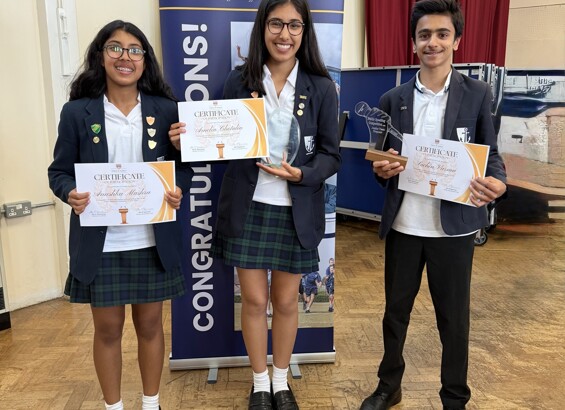
The third DET public speaking competition, open to all secondary schools in the Trust, was hosted by Onslow St Audrey’s on Wednesday 17 June.
Teams from St Clement Danes, Croxley Danes and The John Warner School, travelled to join teams from Onslow St Audrey’s for a highly enjoyable and competitive evening of public speaking as well as a generous tea provided by OSA.
Huge thanks goes to our three visiting judges who gave up their time and praised the pupils for the exceptionally high standard of speaking. Previous judges Ameeta Sabharwal and Rachel Gauke were joined by former St Clement Danes colleague Shand George.
In the Junior competition, Amelia C, Sachin V and Anushka M (SCD) were chosen by the judges for the overall junior prize, debating the topic ‘AI will never take over’. They were praised for their confidence, team work and engagement with the audience. Sachin also won the individual award for best overall junior proposer for his confident well-paced delivery. Jonathan W (OSA) won the individual award for best opposer for his passionate and knowledgeable argument on the ethics of war. Millie F (CDS) won the award for best junior chairperson for her sensitive and good-humoured role chairing the debate ‘Are females better than males?’
In the senior competition, Onslow St Audrey’s team took away the Senior prize for their brilliant discussion of the topic ‘Digital ID: The Uk’s Panacea or Poison?’ which challenged the audience to think deeply about both sides of the argument. Tanvi P impressed everyone with her confident control of the debate and took the prize for best overall senior chairperson, despite being the youngest person in the whole competition - a Year 7 competing in a team with Year 10s. The prize for best senior opposer went to Natalia G (TJWS) arguing against the proposal that paper books are better than ebooks - a difficult argument which she presented with authority and conviction. The final prize, for best senior proposer, went to Malik K (OSA) for one of the most memorable speeches of the night on the topic ‘Is Freedom of Speech Dying?’ - superb content and delivery of an exceptionally high standard.
Congratulations to all of the participants and thanks to Claire Weetman for hosting, as well as all of the teachers involved in preparing their teams. In adjudicator Ameeta’s words:
“The standard of the competition was exceptionally high, and I believe it provided invaluable experience for all participants. It was a delight to listen to their well-prepared and thoroughly researched speeches, and it was evident that a great deal of effort, thought, and commitment had gone into their presentations. The competition created a wonderful platform for participants to develop and showcase their communication skills, and I thoroughly enjoyed being part of the experience”
The competition will return next year to be hosted at Croxley Danes in the summer term.
 Posted on: 10/06/2026
Strengthening our professional culture: Primary Director Sarah King featured in Schools Week
We are delighted to announce that Sarah King, our Primary Director, has recently authored a compelling piece for Schools Week, the UK’s leading education news publication.
In her article, "Why education needs a shared, definitive vocabulary," Sarah explores a strategic challenge that is central to school improvement: the need for a common, precise language across the education sector.
At the heart of Sarah’s argument is the belief that professional clarity is the foundation of excellence. Drawing a comparison between high-stakes industries like aviation and the classroom, Sarah argues that just as pilots rely on standardised procedures to ensure safety, teachers require a shared "meta-language" to ensure consistency and effective practice.
Within our Trust, we are committed to providing the highest quality education for all our pupils. Sarah’s work highlights that when we move beyond ambiguous terminology, such as varying interpretations of "adaptive practice" or "curriculum delivery", we reduce professional anxiety and allow our teachers to focus their expertise where it matters most: the classroom.
Having our leaders contribute to national discourse is a testament to the talent and strategic thinking within our central team. Sarah’s call for a "shared, definitive vocabulary" aligns perfectly with our Trust’s mission to collaborate effectively and drive improvement across all our schools.
We congratulate Sarah on this thought-provoking publication and are proud to have her leadership guiding our primary provision.
Read Schools Week Article >>
 Posted on: 24/04/2026
Croxley Danes School ranks in top 20% nationally following rigorous new Ofsted inspection
Croxley Danes School, a member of Danes Educational Trust, is celebrating a landmark achievement following its first full inspection under Ofsted’s new, more rigorous, evaluation framework. The report, following the inspection on 24 February 2026, places the school within the top 20% of schools nationally.
The updated Ofsted framework has moved away from reductive one-word judgements, opting instead for a nuanced assessment of school performance led by His Majesty’s Inspectors (HMIs). Under these heightened standards, Croxley Danes has secured high marks across all categories, reflecting a deep-rooted culture of excellence.
The inspection evaluated the school against the new grading system, where "Strong" represents performance at an upper-Good or Outstanding level when compared with the old framework. Croxley Danes achieved the following:
Strong Standards: Awarded in Attendance and Behaviour, Inclusion, and Leadership and Governance, indicating that the school is performing significantly above expectations in these areas. These are considered the hardest areas to achieve a Strong grading in, and so to obtain a Strong in all 3 really sets the school apart from others.
Expected Standards: Given in Achievement, Curriculum and Teaching, Personal Development, and Post-16 Provision.
Safeguarding: Formally graded as "Met," with inspectors praising an "open culture" where the safety of students is a shared responsibility.
The report highlighted the positive environment fostered at the school, with inspectors noting "The school fosters a highly inclusive environment where all pupils feel welcomed and valued... Behaviour across the school is extremely positive [and] pupils enjoy positive relationships with staff and each other."
Andy Harris, Headteacher of Croxley Danes School, commented: "I am immensely proud of our pupils for the polite, considerate, and respectful way they conduct themselves every day. This report is a testament to the hard work of our staff and the invaluable support of our parents. Being ranked in the top 20% of schools nationally is a significant milestone, particularly for a newer school, and it validates our commitment to an evidence-informed culture of excellence."
While celebrating this success, the school remains committed to further development. Future initiatives will focus on increasing consistency in student feedback and further refining the personal development programme to ensure all students are fully equipped for the challenges of the wider world.
 Posted on: 20/04/2026
National Recognition for four of our schools in Spring 2026 TEP Census
We are thrilled to announce that four schools within our Trust have been awarded prestigious TEP Engagement Badges following the Spring 2026 national census. These accolades celebrate schools that demonstrate outstanding performance in pupil and employee engagement, placing them among the very best in the country.
To put this achievement into perspective, these badges are only awarded to schools scoring in the top percentiles of a vast national dataset encompassing over 500 schools, 30,000 staff members, and more than 300,000 pupils.
While we celebrate all four schools, we would like to give a special mention to Croxley Danes School and Elstree Screen Arts Academy. Both schools have secured badges for the second time this academic year, having also been recognised in the Autumn 2025 census. Maintaining such high standards across consecutive censuses is a significant feat and serves as a powerful indicator of a sustained, positive culture for both learners and staff.
The specific areas of excellence recognised this term highlight the diverse strengths across our Trust:
Croxley Danes School (Secondary)
Top 5% Nationally: Employee Leadership
Top 10% Nationally: Employee Inclusion and Employee Satisfaction
Awarded in both Autumn 2025 and Spring 2026.
Elstree Screen Arts Academy (Secondary)
Top 5% Nationally: Pupil Inclusion, Pupil Enjoyment, and Pupil Recommendation
Awarded in both Autumn 2025 and Spring 2026.
Onslow St Audreys School (Secondary)
Top 10% Nationally: Employee Leadership
St Clement Danes School (Secondary)
Top 10% Nationally: Pupil Recommendation and Employee Line Management
These results are a testament to the hard work, dedication and vibrant community spirit within our schools. Whether it is ensuring our pupils feel included and inspired, or fostering a leadership environment where our staff can thrive.
Congratulations to the pupils, teachers and leadership teams at Croxley Danes, ESA, Onslow St Audreys and St Clement Danes for this remarkable national recognition!
 Posted on: 10/03/2026
Future engineers: Pupils explore STEM horizons at UCL
On Thursday 26 February, Year 12 Physics pupils from across the Trust descended upon University College London (UCL) for the inaugural Trust physics and engineering day. The event marked a significant milestone for the Trust, providing pupils with an immersive, first hand look at world-class academics and the diverse career pathways within the STEM sector.
Designed to bridge the gap between A-Level theory and real-world application, the day saw pupils trading their standard classrooms for UCL’s cutting edge laboratories and lecture theatres. The initiative aimed not only to showcase university life but also to highlight the interdisciplinary nature of modern engineering.
The heart of the visit lay in a series of specialist workshops led by prominent academics. Pupils engaged with various fields, including:
Electrical and Electronic Engineering: In a standout session, pupils programmed mini-processors to calculate and execute the launch of model catapults, blending coding logic with physical mechanics.
Medical Physics: Pupils explored the future of healthcare, getting up close with advanced brain imaging technology and discussing how physics is used to save lives.
Chemical Engineering: Seminars provided insight into sustainable energy and the molecular design of the future.
Beyond the technical skills, the day was structured to spark curiosity about life after Sixth Form. By meeting with leading specialists, pupils were able to ask probing questions about university admissions, research opportunities, and the global demand for skilled engineers.
The event concluded with a tour of the historic UCL campus, leaving pupils with a clear vision of the opportunities awaiting them in the world of higher education. Following the success of this first event, we look forward to making the physics and engineering day a staple of its academic calendar.
Category / All Articles
Categories
Archive